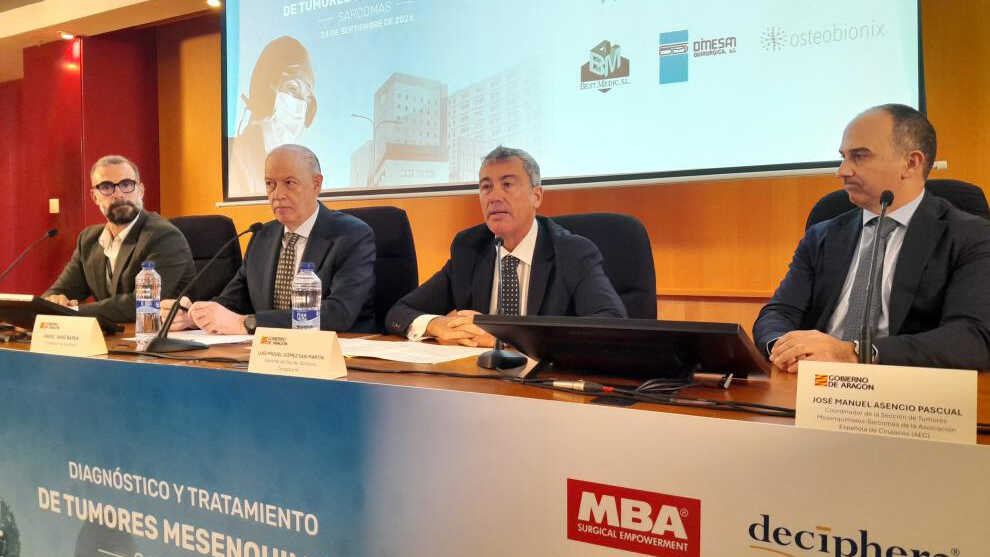
These advances are at the heart of the First Multidisciplinary Meeting on the Diagnosis and Treatment of Mesenchymal Tumors (Sarcomas), being held this Thursday at the Hospital Clínico Universitario Lozano Blesa in Zaragoza. The event brings together more than 120 specialists from across Spain and Portugal and was opened by Aragón Government Health Councillor Ángel Sanz. The meeting addresses a disease that accounts for around 1% of malignant tumors in adults, but approximately 15% in minors.
Sarcomas encompass around 150 different types of tumors and can develop in both soft tissues (such as fat, muscles, blood vessels, joints or tendons) and bones. Their variety, along with the fact that they often produce no specific symptoms, makes early diagnosis particularly difficult. Vicente Borrego, the surgeon responsible for Peritoneal Oncology and Sarcomas at the Clínico, describes them as a “deceptive enemy, often invisible,” precisely because they can develop in internal areas without providing clear warning signs.
ARTIFICIAL INTELLIGENCE AND 3D TECHNOLOGY ARE CHANGING SARCOMA SURGERY
One of the areas where the greatest progress has been made is surgical planning through 3D reconstructions. These models allow specialists to determine more precisely where the tumor is located and how it relates to nearby organs and structures before entering the operating room. This is complemented by radiomics, a technique that analyzes medical images with the help of artificial intelligence to extract information that may be useful for diagnosis and treatment planning.
Robotic surgery and other minimally invasive techniques are also making it possible to perform less aggressive procedures and promote faster recoveries. In addition, the use of fluorescent substances such as indocyanine green helps surgeons visualize the tumor’s boundaries and the structures surrounding it, which is particularly important when the sarcoma has diffuse growth. According to data presented during the meeting, these advances have helped bring surgical complications to around 15% and local disease recurrence to approximately 10%.
3D printing has also driven the development of prostheses and bioreplicas that facilitate increasingly complex reconstructive surgeries. Jesús Gómez, head of the Clínico’s Traumatology Department, highlighted how these improvements can offer alternatives to amputation for certain patients. In the specific case of osteosarcoma, he noted that five-year mortality has fallen from 60% to 40%, an evolution linked to advances made in recent decades in both surgery and complementary treatments.
PRECISION MEDICINE TO FIND THE MOST SUITABLE TREATMENT
Innovation is not limited to the operating room. Molecular and pathological anatomy studies make it possible to identify cellular markers and therapeutic targets that can be addressed with specific treatments. During the meeting, oncologist Isabel Pajares highlighted the development of precision medicine, which seeks to adapt treatment to the specific characteristics of each tumor and patient, despite the research challenges posed by a group of cancers considered rare.
Among the examples presented was giant cell tenosynovial tumor. Pajares noted that the phase III MOTION study achieved a 56% reduction in tumor volume with a new drug-based alternative, which could help avoid repeated surgeries and improve the quality of life of some patients. For Vicente Borrego, progress in artificial intelligence, 3D technology, oncology and pathological anatomy is already translating into “better quality of life, improved survival and lower local disease recurrence.”
The Clínico Lozano Blesa has had a multidisciplinary model for treating these tumors for more than three decades. Its Sarcoma Committee currently brings together 20 professionals from more than ten specialties, including Oncology, Traumatology, Surgery, Radiology, Rehabilitation and Pathological Anatomy. The meeting held in Zaragoza includes five sessions devoted to bone sarcomas, soft-tissue sarcomas, GIST tumors, the role of nursing and the patient perspective, and features specialists from hospitals in Zaragoza, Madrid, Barcelona, Santiago de Compostela and Lisbon.