
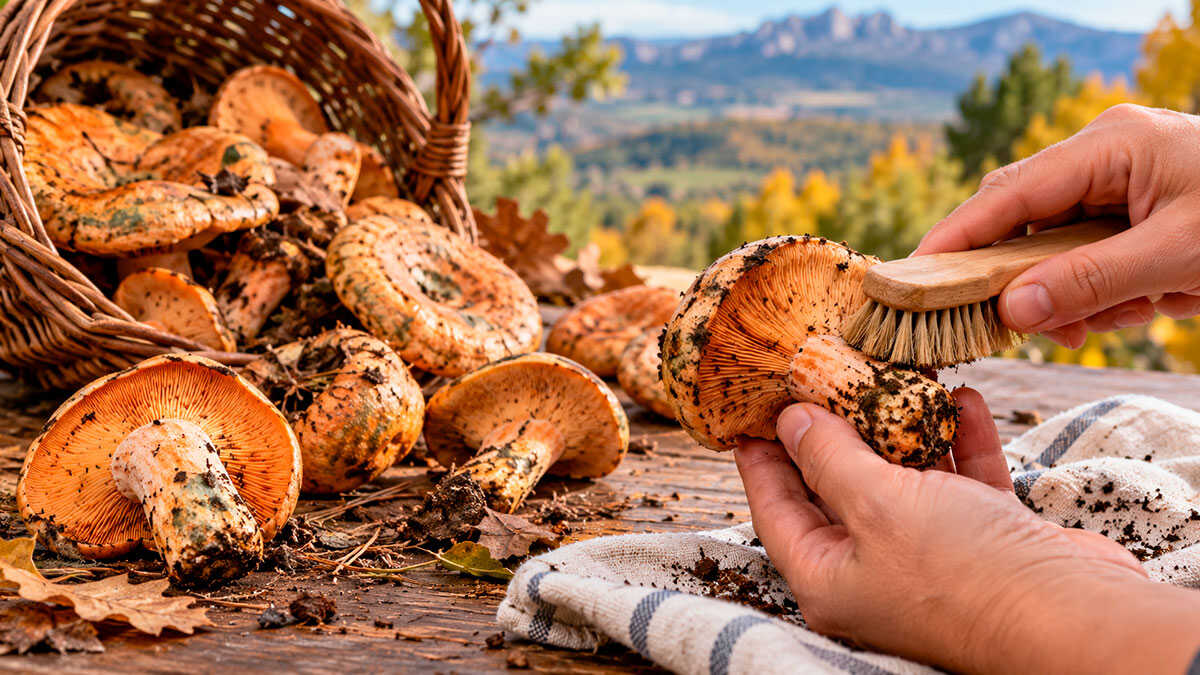
These mushrooms often arrive home with traces of soil, leaves and other small particles of dirt adhering to both the cap and the stem. Although cleaning them may seem like a laborious task, the truth is that all it takes is following three simple steps to leave the rebollones ready to cook without damaging their texture or altering their flavor.
FIRST STEP: REMOVE SOIL AND VEGETATION
The first thing to do when cleaning freshly picked rebollones is to remove the most visible dirt. As they grow in forests, especially pine forests, these mushrooms commonly accumulate leaves, pine needles, small branches and traces of soil that should be removed before they reach the frying pan.
To do this, simply shake each rebollón gently and use your fingers to remove the larger pieces of vegetation. It is important to handle them carefully, as these are delicate mushrooms that can break if squeezed too hard.
During this first step, it is also common to find green patches on rebollones. These colors may appear as a result of the mushroom's natural oxidation and do not necessarily mean that it is spoiled. However, it is advisable to check their firmness and discard any specimens showing signs of rot, mold or deterioration.
SECOND STEP: CLEAN THE REBOLLONES WITH A BRUSH OR DAMP CLOTH
Once the most visible dirt has been removed, it is time to clean the caps and gills of the rebollones. The best option is to use a soft-bristled brush or a slightly damp cloth, carefully wiping the entire surface to remove any remaining traces of soil.
One of the most frequently asked questions is whether rebollones can be washed with water. Although it is preferable to begin with dry cleaning to prevent them from absorbing unnecessary moisture, if they still have traces of soil, they can be briefly rinsed under a gentle stream of cold water just before cooking.
The important thing is not to leave them soaking for long periods, as they can absorb water and lose some of their texture during cooking. After rinsing them, gently dry them with kitchen paper or a clean cloth to remove excess moisture.
THIRD STEP: CUT OFF DAMAGED PARTS AND CHECK EACH REBOLLÓN
The final step in cleaning rebollones properly is to inspect each specimen and remove any parts that are not in good condition. Using a pocketknife or a small knife, you can cut off the lower end of the stem, where more soil tends to accumulate, and remove any deteriorated areas.
It is also advisable to check that the mushrooms do not have small holes, tunnels or signs of larvae. If the damage is localized, the affected part can be removed, but if the rebollón is severely deteriorated, soft or showing signs of decomposition, it is best to discard it.
Once these three steps have been completed, the rebollones will be ready to cook. They can be prepared on the grill with garlic and parsley, added to stews, sautéed with other vegetables or served as an accompaniment to meat and rice dishes.
If they are not going to be eaten immediately, it is best to store the rebollones in the refrigerator or even freeze them in a container that allows ventilation, and cook them as soon as possible. This way, their characteristics will be better preserved, allowing you to enjoy one of the most traditional flavors of autumn in Aragon.