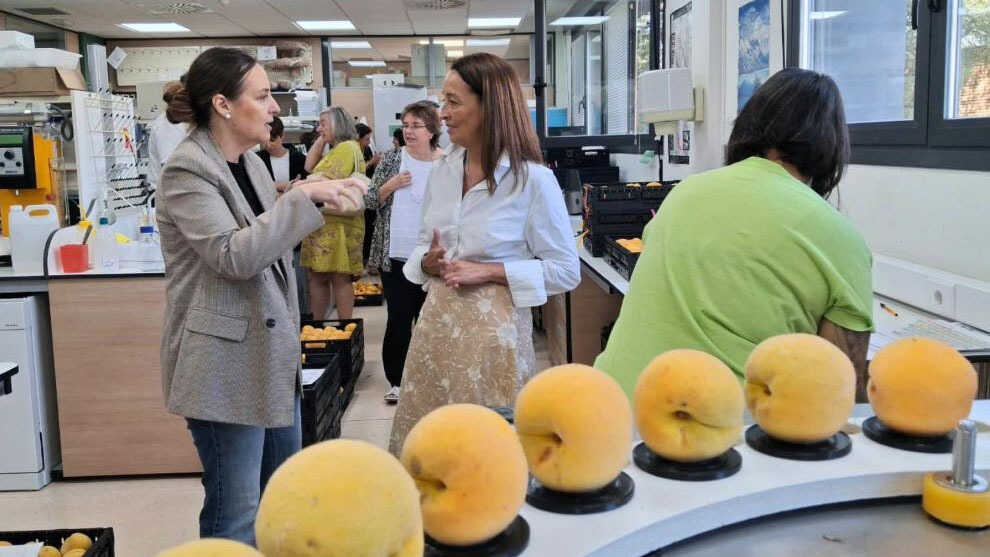
During the tour, Susín visited the Plant Science in vitro cultivation area and the new sensor-equipped experimental sheep facility, fitted with advanced technologies for the digitalization and individual monitoring of the animals. The facility has received funding from the national government, through the State Research Agency, and from the Government of Aragon.
“At CITA, we find projects that place us at the forefront, as well as examples of the talent that is nurtured and grows in our autonomous community,” Susín said. The minister also defended the need to “support and care for talent,” particularly among young people, to strengthen Aragon’s position as a center of scientific excellence.
NEARLY 250 EMPLOYEES AND ACTIVITIES ACROSS ARAGON
CITA currently has nearly 250 employees and carries out its work both at its headquarters in Montañana and at several farms and specialized centers spread across Aragon’s three provinces. Research staff account for 24.1% of the workforce, followed by farm staff, research technicians and laboratory personnel.
Based on this structure, the center works to promote research, foster innovation and technological development, and strengthen cooperation between the public and private sectors. Its areas of activity include fields such as animal and plant science, agricultural and forestry systems, and the agri-food economy, with particular attention to the transfer of knowledge to the region.
During 2026, CITA took part in knowledge-transfer and outreach activities in 80 Aragonese towns and signed contracts and agreements with companies and institutions in 59 municipalities across the autonomous community. The center’s managing director, Pilar Errea, also highlighted its work on sustainability, farm profitability and adaptation to climate change.
The visit coincides with the publication this Friday in the Official Gazette of Aragon of the resolution awarding grants to research groups for the 2026-2028 period. The call is endowed with 10 million euros and will reach 285 groups and around 6,100 researchers and technicians, 10% more groups than in the call corresponding to 2023.