Last academic year, the University of Zaragoza welcomed 3,901 students from 123 countries through the different mobility programs offered by the academic institution. This year, around 600 students are taking part in the Erasmus program, the largest source of incoming students.
Most students come from countries such as Italy (496 students), Romania (451), China (356) and France (271). Among students from Latin America, Mexicans, Colombians, Peruvians and Ecuadorians are the most prominent.
The opportunity to travel to other places, Zaragoza’s history and culture, learning Spanish and the university’s prestige are the main reasons these students chose the University of Zaragoza to complete their studies this academic year.
Academic “prestige” is one of the distinguishing factors highlighted by Sergio Salinas, vice rector for Internationalization and Cooperation, compared with other universities in Spain: “Academically, it has good undergraduate and master’s programs, and that is why they choose us.” He also considers the Aragonese capital a “comfortable” city to live in compared with larger cities such as Madrid or Barcelona, which are more “difficult to afford.”
For the university’s other students, he says, living alongside international students is also “enriching.” “They have the opportunity to gain an international experience without leaving home, to share classrooms with people from practically every corner of the planet, and with very different ways of thinking and doing things,” Salinas stresses.
PRESTIGE OR HISTORY AMONG THE REASONS TO STUDY IN ZARAGOZA
For the international students who took part in the welcome event held by the University of Zaragoza on Monday, the reasons they chose Zaragoza to continue their studies are varied. Bulgarian student Eszter Antal, who is pursuing a master’s degree related to Social Work and Occupational Therapy, chose the university to learn how the system and academic approach work, as they are more “practical” than in Romania, where she studied. “I can learn much more and try to apply this system in my country,” she explains.
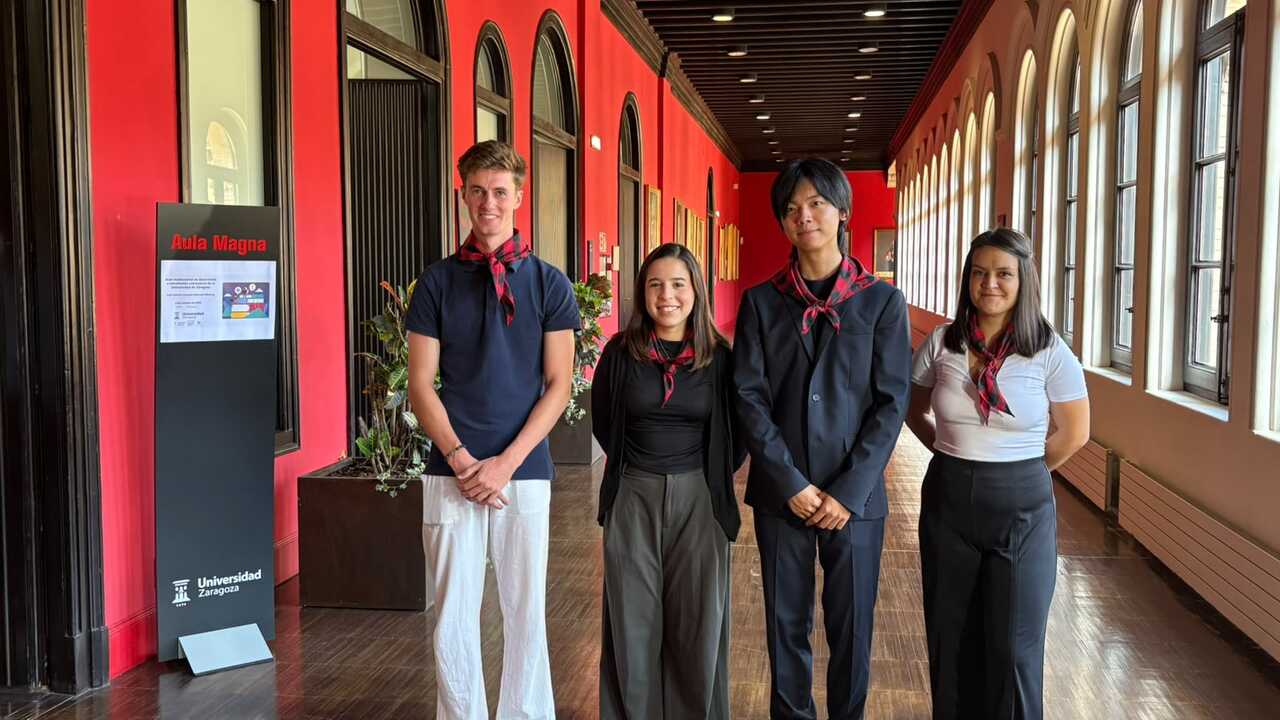
The University of Zaragoza manages nearly a dozen international mobility and development cooperation programs. Photo: Aragón Press
Learning Spanish and traveling around Spain and the rest of Europe are the reasons that brought Zhang Yichi, a Chinese student, overseas. The young Tourism student considers it important to visit other countries and learn about different cultures: “Now I am going to live with a Spanish family, and it is an opportunity for me to learn a language. I also love traveling, and Europe and China are very different.” The Chinese student has already visited cities such as Pamplona, Madrid, Logroño and San Sebastián.
French student Mattéo Morère, who is pursuing a master’s degree in teaching Spanish as a foreign language, has a different story. He had the opportunity to study in Zaragoza last year and did not hesitate to return this academic year: “I was very attracted to Zaragoza because it is close to the Pyrenees, in an area with many beautiful things to see; it is a city with a lot of history and is also close to Madrid and Barcelona. There are many things to do—I didn’t want to get bored,” the young man explains. He also considers being close to another culture “enriching.”
Isis Valeria Veloz comes from Mexico through the Erasmus Mundus program and is studying for a master’s degree in Membrane Engineering. “I am a chemical engineer, and the University of Zaragoza is one of the few universities with such a specific program as this one in Membranes for Sustainable Development,” the student says. Veloz also viewed the “similarity between Mexican and Spanish cultures” as a major advantage, while sharing the same language provided greater “ease.” She also considers it a great “opportunity” to live alongside classmates from countries such as Pakistan and Bangladesh.
MOBILITY PROGRAMS AND SPANISH AS A FOREIGN LANGUAGE COURSES
The University of Zaragoza manages nearly a dozen international mobility and development cooperation programs. In addition to the Erasmus program, the university welcomes students through programs such as Ibero-American Mobility, North American Mobility, Asia and Oceania (Naao), UZ-Santander Doctoral Scholarships, UZ-Fundación Carolina Scholarships, the 1+X Program, the Master’s Program for Chinese Students and the Fundación Mujeres por África Scholarship.
In addition to these international mobility programs, the Spanish as a Foreign Language Courses attracted a total of 425 students last year (the figure does not include Erasmus students, who also enroll in these courses). The largest groups came from China (66), Italy (40), Japan (16), Morocco (23) and Mali (17).