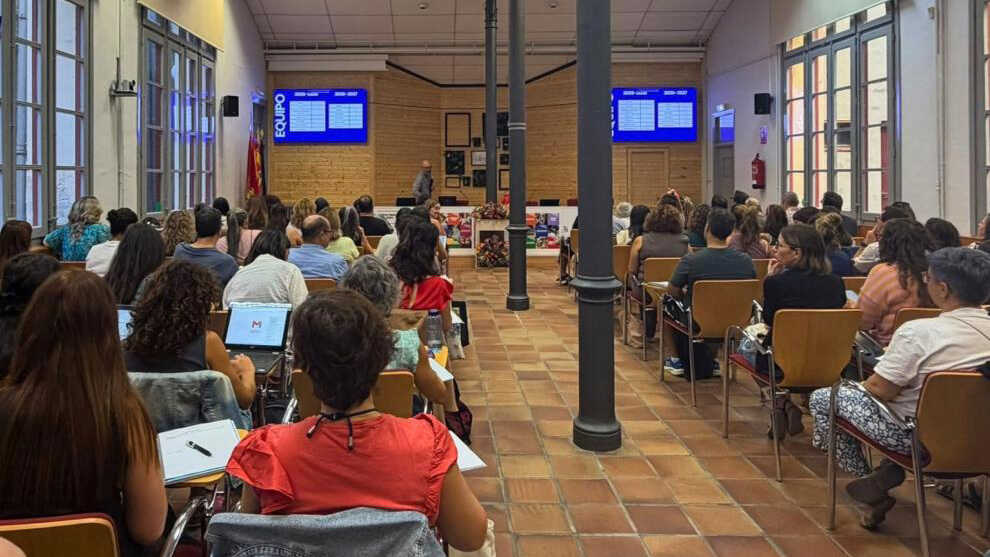
For the regional government, training coordinators play a “key role” in schools, as they are responsible for bringing educational improvement plans into the classroom and updating and strengthening teachers’ skills and training. They also draw up the School Training Plan (PFC), coordinate the design and monitoring of training activities, and exchange best practices with other centers in the network. The government has therefore described them as “the leaders of training in their schools”.
The Directorate General for Educational Policy, Organisation, Equity and Training of the Government of Aragón has identified this ongoing teacher training as the “cornerstone” for improving teaching practice in the classroom, restoring a culture of effort and raising student performance.
FOUR PEDAGOGICAL PRIORITIES
During this latest session, the four pedagogical priorities for the 2026/27 school year were established. The first is to update teacher training in all areas and subjects, prioritising key fields for learning such as mathematics, languages and science. The aim is to consolidate essential knowledge and strengthen Aragón’s position in classroom performance and achievement indicators, such as those included in the PISA report.
The second priority is to promote wellbeing and emotional education in the classroom. To this end, the plan is to work on tools for managing school coexistence, providing comprehensive support and creating safe, study-friendly school environments. It also aims to promote training for management teams in order to foster a culture of educational excellence that facilitates staff cohesion and management based on shared objectives.
Finally, training will be offered not only to develop skills in the use of AI, but also to provide teachers with professional, pedagogical and ethical judgement. The aim is to ensure that the use of this technology follows clear criteria and reinforces students’ effort and autonomy, without replacing the teacher’s guidance.
The plan shared by the training coordinators from the three provinces is structured as a complete cycle: first, these professionals identify the needs of each school; then they design contextualised training that is implemented in the classroom; and finally, the impact of that training is assessed alongside guidance and mentoring from teacher-training centers.
THESE ARE THE CENTERS
The full list of the ten teacher-training centers by province is as follows: in Huesca, CP Ana Abarca de Bolea in Huesca, CP de Monzón and CP de Sabiñánigo; in Zaragoza, CP Juan de Lanuza and CP María de Ávila, both in the capital, as well as CP de Calatayud, CP de Ejea de los Caballeros and CP de La Almunia de Doña Godina; and in Teruel, CP de Alcorisa and CP Ángel Sanz Briz in Teruel.
Each CP also has branch offices or territorial teams that bring support services closer to rural schools. The aforementioned network is completed by specialised centers such as the Aragonese Center for Educational Technologies (Catedu), the Aragonese Center for Foreign Languages in Education (Carlee), the Aragonese Reference Center for Equity and Innovation (Carei) and the Innovation Center for Vocational Training in Aragón (Cifpa).