QUESTION.- Since 2023, Dr. Schär has invested €38.8 million in Alagón. Why is the group focusing such a significant investment on this plant, and what does Alagón offer that other locations do not?
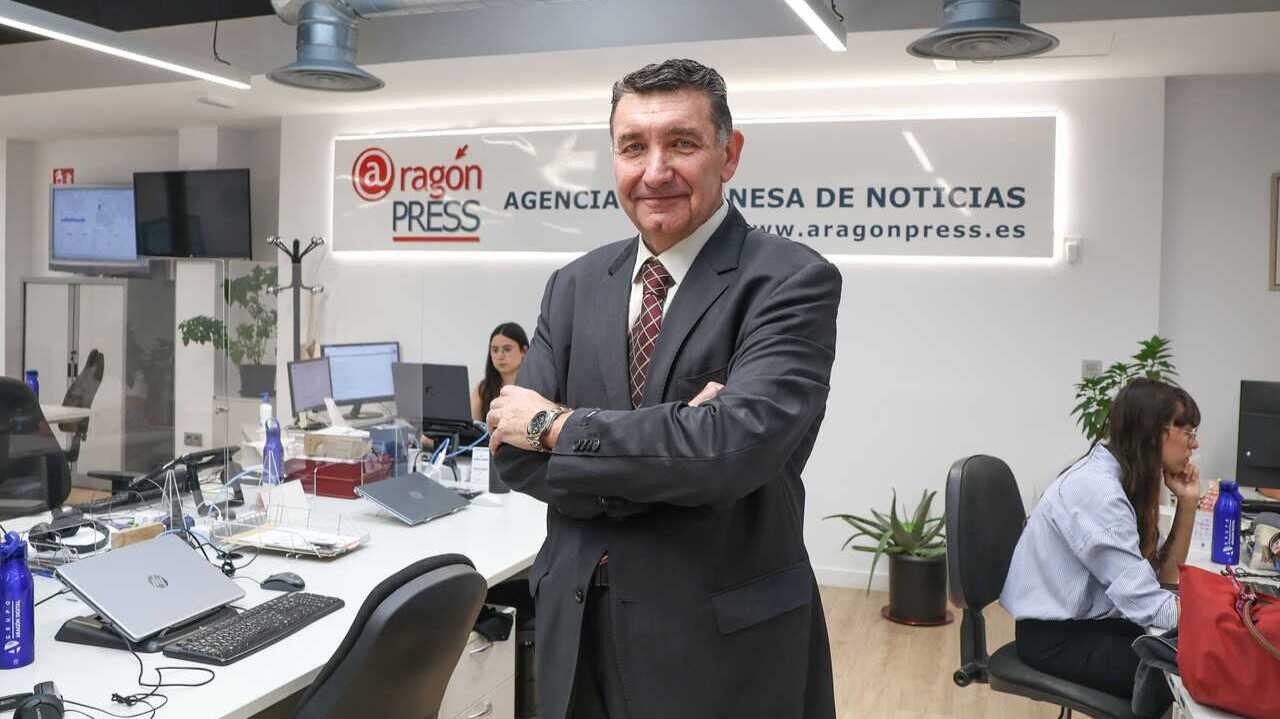
ANSWER.- We are in Alagón, Zaragoza, because the company Dr. Schär acquired in 2011 was my former company, Natural Aliment Factory, which was the market leader in Spain and also sold products in Central European countries, Italy, Germany and England. That was the main reason Dr. Schär took an interest in my company.
But there are other reasons. We have been making a quality product for many years, and our company’s expertise was one of the key factors behind the acquisition. In addition, Zaragoza’s logistics were perfect for the group because from here we can reach markets such as Spain and Portugal, we have links with South American countries, and we can easily sell to France and the United Kingdom.
And, so far, it has always been an easy place to invest from an administrative perspective. I hope that does not change, because the authorities have been understanding of the environment, have supported us and have made it a convenient place to continue investing.
Q.- In this latest expansion, you doubled gluten-free bread production capacity. Have you reached a growth limit, or is there still room for further investment at the Alagón plant?
A.- Since 2011, we have never stopped investing and growing. Right now, we are in a stabilization phase. This plant, with the investment you mentioned, is the cornerstone of other investments we have made over the years. We have exceeded €70 million in investment in recent years. In this latest phase, we filled the existing facilities with this expansion, but we have another 10,000 square meters available to continue expanding. In reality, stabilizing a line like this is extremely difficult. For now, we are focused on that, on delivering the results to the group that we have always delivered and on being a company that generates good performance on its investments.
Q.- Production of gluten-free products must have changed considerably since you began. What have been the most noticeable changes?
A.- In our case, when the company was mine, we had a semi-industrial process. When Dr. Schär arrived, we combined my experience in the gluten-free market with the strength of the number-one multinational company. What happened was that we industrialized the process 100%. The company’s use of robotics is comprehensive. There are production lines that can be operated by six or seven people and produce thousands of units per hour. This industrialization is what has changed the most.
When you make something at home, it usually turns out well; when you take it to a bakery or pastry shop, it changes, and when you take it into an industrial process, the product changes even more. Achieving the same flavor and quality while preserving the characteristics of a homemade product is the difficult part. Moving to an industrial process while maintaining high quality is what has changed over the years.
When you make something at home, it usually turns out well; when you take it to a bakery or pastry shop, it changes, and when you take it into an industrial process, the product changes even more
Q.- What role does Aragón play within the company?
A.- The Autonomous Community of Aragón has a very important logistics hub. We are people with considerable experience in production lines and, within the group, we are Dr. Schär’s strongest company. We are the strongest in terms of units manufactured and millions produced. We have achieved that over these 15 years, and I am proud of it. I believe that our company in Spain is an example throughout Europe and the world. Today, it can be said that Alagón is home to the strongest production operation of the world leader in gluten-free food.
Dr. Sachär has exceeded €70 million in investment in recent years. Photo: Pilar Álvarez
Q.- Alagón is the group’s only factory producing certain baked goods for all the countries where Dr. Schär operates. How do you manufacture the same product in Aragón for markets that can be so different?
A.- We manufacture all of the Dr. Schär group’s baked goods here. We also make sliced bread, baguettes and sweet breads, but the latter are made for specific markets: Spain, Portugal, France, the United Kingdom, and we also ship products to the United States. However, all the group’s baked goods are manufactured here.
All the group’s baked goods are manufactured here
How do we do it? It is complicated, but first we have to focus on international products. We are talking about a muffin, a muffin with jam or a plum cake. These are products sold around the world and are international, just as Italian pizza is. We have a factory in Italy that makes pizzas, but pizza is sold worldwide. We do something similar with baked goods, focusing first on important products around the world. From there, we develop specializations. We need a flexible baked-goods line, and we have achieved that, making products such as crostatina, a typical Italian product, as well as other local products.
Q.- What percentage of Alagón’s production is currently destined for export?
A.- We are at 85%, but that will continue to grow and reach 90% soon. In reality, for sales in Spain we also source products from other production plants in the group. In other words, we buy pizza from Italy and cookies from Germany. Just as we make baked goods for the entire group, specific group companies manufacture products for us. We sell 110 products in Spain, and we do not manufacture all of them here; we source them from other group companies.
Q.- People did not used to talk as much about gluten intolerance. Now there seem to be more diagnoses, not only of celiac disease but also of other sensitivities. Have you noticed this increase?
A.- All people with celiac disease are now being diagnosed. Years ago, it was more complex, as even general practitioners sometimes did not know what celiac disease was. Awareness over all these years has been very important. I have worked in the gluten-free sector since 1997, and it has changed enormously over these nearly 30 years. Celiac disease was much more difficult to diagnose in the past, and today we know that around 1% of the population has celiac disease and that up to 5% may have gluten intolerance or sensitivity.
The company exports 85% of its products. Photo: Pilar Álvarez
For us, the important thing is to meet a dietary need, and people with celiac disease remain our main focus. That does not prevent other people from consuming gluten-free products, just as they may choose sugar-free products. Our differentiation is also important in the celiac market because we do not use preservatives. Preservatives are, of course, permitted. I am not going to say that they are good or bad, but clearly, a person with celiac disease whose intestinal flora is more damaged may not tolerate a preservative as well as someone else.
Our decision and philosophy, based on conviction, is not to use preservatives. That does benefit us when it comes to offering a product perceived, so to speak, as healthier and less chemical.
Q.- Gluten-free products tend to be more expensive than conventional products. What is the main obstacle preventing this gap from narrowing further?
A.- It is a long-standing saying: gluten-free products are expensive. Clearly, gluten-free products contain many ingredients that are not conventional. In conventional bread, we are talking about water, yeast, salt and flour. In our case, a product may contain up to 20 components to make up for the lack of gluten.
Some raw materials are more expensive than usual. We will never reach the same price level as conventional bread or conventional products. What has happened is that the gap has narrowed considerably compared with 26 years ago. And we should bear in mind that when you set up a line and we are talking about €38 million or €40 million in this latest investment, we work for 1% of the population. The lines cannot be amortized in the same way as if you were working for 100% of the population. Clearly, prices have improved significantly, and today people with celiac disease can find much more attractive prices.
Some raw materials are more expensive than usual. We will never reach the same price level as conventional bread or conventional products
In some countries, the state helps people with celiac disease through vouchers that can even be exchanged for products at pharmacies or supermarkets, as happens in Italy. They offer discounts on gluten-free products because it is a need resulting from an illness, and people cannot stop consuming certain products. That does not happen here. If we really had state support for this group, prices would be reduced to a minimum, as happens with medication.
Q.- What are Dr. Schär’s future goals in Alagón?
A.- We have 210 permanent and temporary employees, and around 250 people work at Dr. Schär every day. Our future objectives involve consolidating Dr. Schär and ensuring that the people who work for us become important within the group. That is one of my personal goals: for the staff who have been with me for so many years, as well as the new employees who have joined with potential, to develop within the company. And I will obviously continue working on new projects for the next two or three years.