The event, held in La Cartuja Baja, brought together business representatives, specialists and institutions to address some of the issues shaping the present and future decisions of industry: the availability and cost of energy, resource efficiency, access to strategic raw materials, the decarbonization of production processes and the incorporation of new fuels.
Airbe President Armando Mateos opened the event and highlighted the association’s commitment to helping sustainability become an effective part of business strategy. “With this third edition, we want to continue promoting sustainability as an element closely linked to the competitiveness of our companies, bringing together experiences, success stories and solutions that enable progress toward more efficient and sustainable production models,” Mateos said.
The Airbe president also stressed the importance of creating spaces that foster relations and cooperation between companies from different territories. “This forum also has a clear focus on business networking and collaboration. In this edition, we wanted to strengthen ties between companies in the Lower Ebro Valley and the Cinco Villas region, facilitating the exchange of experiences, projects and solutions that can create new opportunities for collaboration and contribute to strengthening the business fabric,” he added.
FROM ARAGON’S RENEWABLE POTENTIAL TO INDUSTRIAL CONSUMPTION
The opening conference, “Renewable Aragon: From Energy Generation to the Industrial Consumption of the Future,” was delivered by Pedro Machín, president of the Aragon Energy Cluster and CEO of Grupo Atalaya. He analyzed the region’s energy potential, the development of renewable energy and one of the main challenges of the coming years: efficiently connecting energy generation with industrial demand and the territory.
During the event, issues such as energy costs, resource efficiency and access to raw materials were discussed.
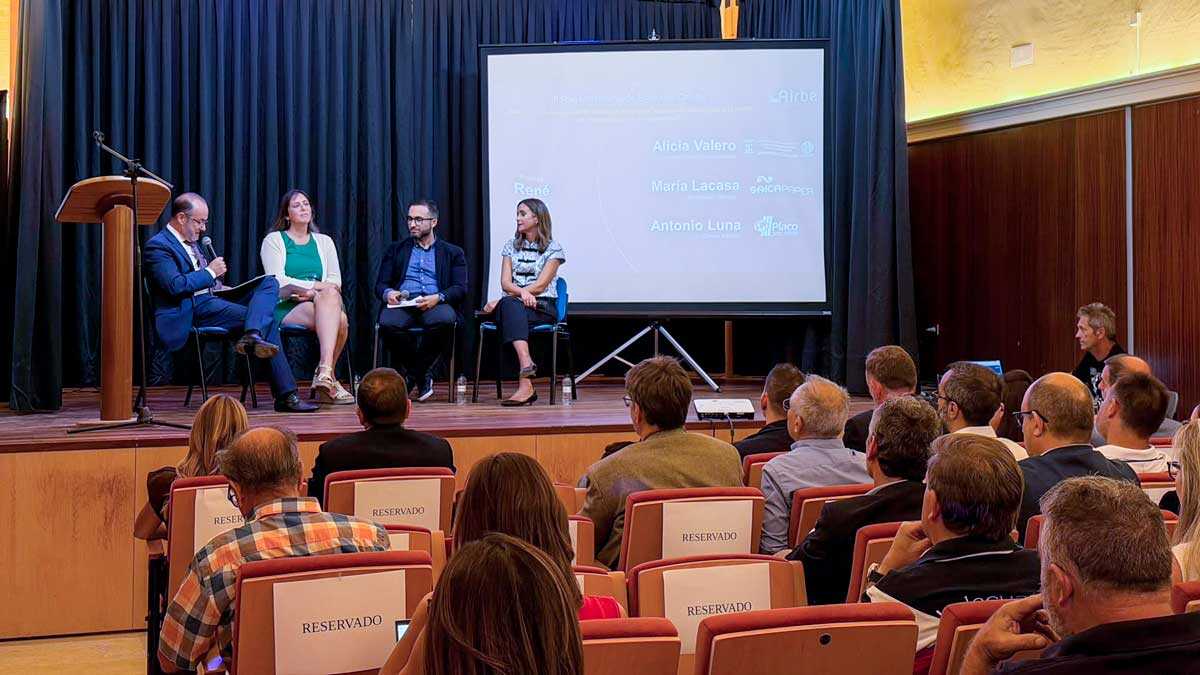
Materials management was another of the forum’s major themes. The roundtable “The Invisible Mine: Industrial Costs, Strategic Autonomy and the Regenerative Power of Materials,” moderated by René Sanz, director of Sustainability and Circular Economy at Grupo Itesal, examined the value hidden in industrial waste and the opportunities its recovery offers to reduce costs and dependence on raw materials.
Participants included Alicia Valero, director of the Industrial Ecology Group at the Energaia Institute and the Cemex Sustainability Chair; María Lacasa, Environment Manager at Saica Paper Spain; and Antonio Luna, Industrial Director at Placo Saint Gobain Aragón. The discussion addressed issues such as the future availability of strategic raw materials, the capacity to recover materials and the transformation of environmental costs into new opportunities for industry.
SUFFICIENT ENERGY FOR GROWING DEMAND
Another major question addressed at the event was the energy system’s ability to respond to the needs of an increasingly electrified economy. Under the title “Will There Be Enough Energy? Keys to Understanding the Future of Spain’s Electricity System,” Xavier Cugat, from Revenergetica, analyzed the operation and evolution of the electricity system, the expected growth in demand and the challenges this scenario poses for both companies and territories.
The 3rd Business Forum on the Circular Economy also examined specific initiatives already being promoted across Aragon’s productive sector.
The 3rd Business Forum on the Circular Economy also examined specific initiatives already driving the energy transformation of Aragon’s productive sector. The roundtable “New Energies and Solutions to Transform the Production Model,” moderated by industrial environmental management expert Fernando Follos, brought together different perspectives on experiences and solutions that can help transform the energy and production model. Participants included Jesús Miguel Gaspar, head of maintenance at Cárnicas Cinco Villas; Fernando Ederra, manager of the Tauste Manure Management Center; and David Revuelto, production manager at the waste transfer plant of Adiego Hermanos.
The exchange made it possible to analyze the degree of development of these projects in Aragon, the needs of consuming companies and the potential of new energy solutions to reduce emissions without losing competitiveness.
ARAGON AND THE ENERGY AND CIRCULARITY CHALLENGE
Yolanda Vallés, director general of Energy and Mines of the Government of Aragon, closed the event with the presentation “Aragon and the Energy and Circularity Challenge,” providing an institutional conclusion to a day focused on connecting the energy transition, the circular economy and industrial development.
Yolanda Vallés, director general of Energy and Mines of the Government of Aragon, closed the event with the presentation “Aragon and the Energy and Circularity Challenge.”
“Aragon faces an extraordinary opportunity to harness its energy potential and put it at the service of industry, employment and the territory. The challenge is not only to produce more renewable energy, but also to ensure that this energy helps generate economic activity, attract investment and strengthen the competitiveness of our companies,” she concluded.