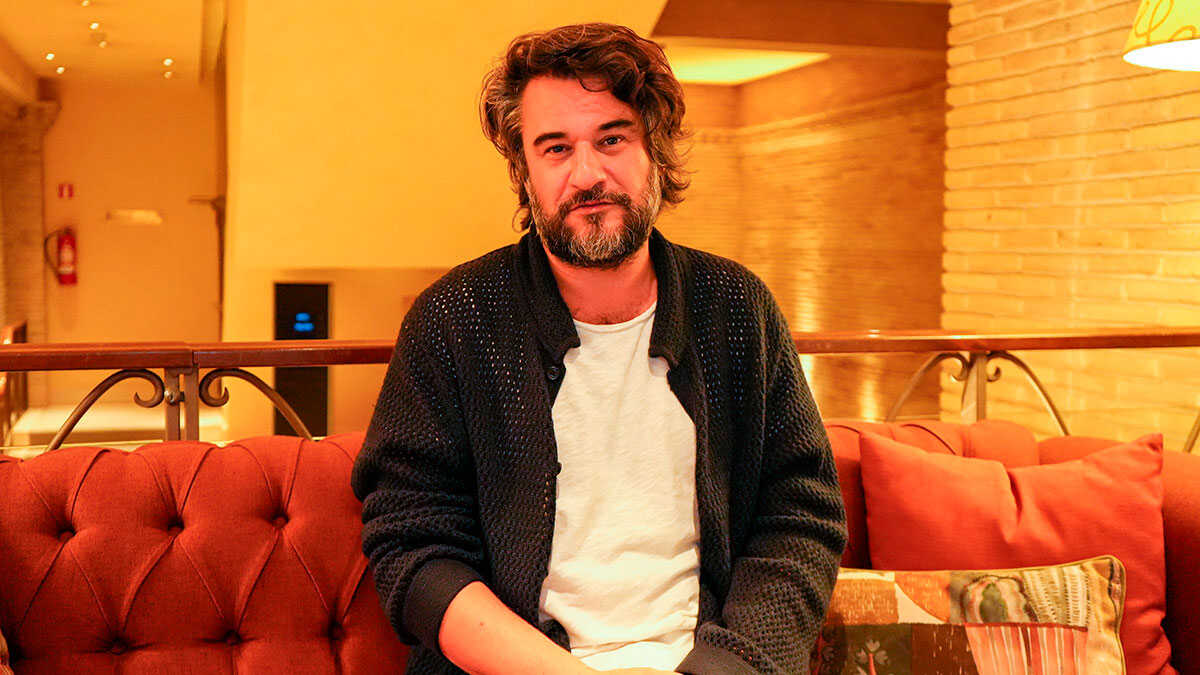
A married couple, two children (one wanted, the other not), a Galician village and the disappearance of two children form the basis of what is said to be Jabois’s best novel. He presented it in Zaragoza on Tuesday.
QUESTION.— Amalia dismembers that rabbit and, a few pages later, goes after a pimple on her husband’s back. How did you come up with such an opening?
ANSWER.— It comes naturally to me because I have popped quite a few pimples (laughs). I’ve had bad luck with my partners... And I’ve also seen a rabbit being gutted. The question is why write about it, why leave a record of it. Other images were censored, edited and cut because the novel was very sensory. You could smell it, and not pleasantly; many things could be smelled. I really like that, for novels to have and also engage the senses. I know smell and taste are impossible... for you to suddenly read something and feel something unpleasant because the novel itself is unpleasant.
Things were cut because I became too scatological, as my editor told me. I had come from novels that were written very beautifully, and suddenly I thought that I also knew how to write un-beautifully. There are things I don’t like much about some fiction. For example, I’ve just watched Vikings and loved it, but, come on, they all have perfect teeth. Impossible. Those people either had no teeth or had two teeth, and that isn’t reflected. They must have smelled terrible, and I understand that people get used to bad smells and that nobody is going to spend all day saying that someone smells bad, but... These are things that don’t come across to me on screen.
I understand that readers may be shocked, but that is life.
Q.— “How far would you be willing to go for your family?” That is the question running through the entire novel. Have you reached any clear answer? A.— No, to be honest, this bleak story has left me with many doubts. I had never really asked myself that question, because I have never had to defend my family. I have never had relatives caught up in scandals, controversies or prison, or been the victims of public lynchings, or whatever.
So, well, of course I would defend them, obviously, but there are always buts. This novel has taught me that there are always buts; even in the most sacred things, there are buts. I would defend my son to the death, but perhaps you might find some but. I’m not talking about that matter in this novel; I’m talking more about love from the bottom up, but perhaps there are buts there too.
Q.— Amalia is a housewife who cooks on four burners, but then picks up her grandson and thinks about what would happen if she threw him out the window... A.— Who hasn’t thought about it! When you have a baby in your arms who won’t stop crying, I know very few people who, by the tenth cry, haven’t said: “Holy shit! What would happen?” I’m joking... But what is true is that I was very interested in expressing the idea that some things seem so easy that merely thinking about them makes it feel as if you had already done them. Sometimes you look out a window and think how little time it would take to throw yourself into the void. It crosses her mind superficially, and she thinks about how easy life would be, because some things are very, very easy.
Q.— She may not be a psychopath, but you have to admit she has some issues. Are you particularly interested in these kinds of characters? A.— Yes, well, I don’t know anyone in my real life who doesn’t have issues. We all have them, more or less prominent and of different depths, but there would be no literature without flaws. Perfection does not exist, and perfection is also very boring. The beautiful thing is loving someone with their imperfections and defects, accepting them. It depends on how deep those defects are.
Amalia is a fascinating person because we are generally used to seeing people with her problem, which is something close to psychopathy, with a lack of empathy, guilt and remorse... She can act like a superheroine in the sense that, since nothing hurts her, she can keep surviving in a hostile environment. But at the same time, she is a housewife; she is not an IBEX executive. She does not hold a decision-making position among this country’s economic, social, political or cultural powers, which is where many psychopaths end up—people who do not care about stepping on heads and betraying friends because they will sleep just as well. She sleeps just as well, but she is not in that war. So I found it very interesting to place Patrick Bateman, the protagonist of American Psycho, in a Galician kitchen, cooking for everyone and trying to be good.
Saying, I don’t want to kill, I don’t want to do anything I could do, but I want to be good; I want to imitate what others do, which is generally good.
Q.— Was she born bad or did she become bad? A.— No, no, I don’t think she is bad. She is born with an illness, as you said earlier, with a serious, significant emotional flaw. But I know people who have those flaws and are not bad; they want to be normal. They don’t go around hitting people. She imitates goodness and makes an effort to do so. She spends the novel’s 200 pages fighting to be normal. She sees someone doing good and imitates them; it is difficult for her to love, and that’s a real burden. It is a real burden when you have a child and suddenly feel that you are not worrying about him. She is trying to love people she is supposed to love because she has to, by nature, by biology, because that is what is normal, and she fights against it. I find that very moving. In the end, she does evil, but she doesn’t do it because she is bad; she simply does it so that the joy afterward will be greater and she can earn some kind of medal.
Q.— We have Mon and Chami, the wanted child and the unwanted child. At some point, they consider making the least wrong decisions and realize that the bottom they thought they had reached does not exist. A.— Some people have no bottom. It is a misfortune to have a bottom. In fact, once you hit rock bottom, congratulations and help begin, as do solidarity, bank accounts into which people deposit money to help you, accepting blame and looking for those who brought you down... All of that starts lifting you up. But people like Chami have no bottom because he also finds a certain pleasure in breaking himself apart. That ongoing present. Once he is broken, he knows things turn toward compassion. And compassion is an emotion in others that is difficult to bear. So you prefer to be hated rather than pitied. It is the final rung.
“Many times you prefer to be hated rather than pitied”
Q.— In this novel, what is left unsaid is infinitely more revealing than what is said. What was it like putting words to silence? A.— Slow. It is a short and very slow novel—not to read, because I think it reads well, but I wrote it very slowly. It took time because I had to work with implications, silences, looks, and, as I mentioned earlier, smells and flavors. It was complicated. It is the eve. It is not the big day; it is not Amalia’s birthday. No. So everything is about to happen, but do we know whether it happens? No, it doesn’t. And that may be frustrating for you as a narrator and for the reader. In the end, everything happens, but it all happens backward, not forward. We do not know what will happen on that birthday. The family is probably united, happy and calm, but we do not know what will happen on that birthday. It’s tough.
It’s tough. Writing it wasn’t. I have a good time writing, but it is true that it took work. A family that does not talk to one another and does not tell each other things—I have to tell them in another way.
Q.— The reader is left thinking... A.— Yes. I like books that do not resolve everything for you; I really don’t like moral lessons. Everything happens in this novel, and the story remains there. It is complete, but I do not grab the reader by the shoulder and say: “Look, I’m going to explain how this happened now. We must always stick together, we must be strong...” No.
I hate good novels in the sense of “I’m going to make you a better person.” “I’m going to make you a better person” is a horrible thing, the very opposite of an example. But I don’t like conclusions or moral summaries. Sometimes one may slip through. I loved Society of the Snow; it is a terrific film, but at the very end there is a voice that says something along the lines of how we must learn to stay together, that we have to eat whoever we can to survive. We already knew that. There was a lesson in that film, and it is a beautiful lesson, but it did not need to be underlined with that sentence. I would not like to contradict Bayona now, because I think he is a hell of a director, but when I heard that sentence at the end, I thought, what a shame.
Q.— Amalia is married to Ramón, a man who, unlike her, never gets up from the armchair and speaks as little as possible. Their marriage begins in murky circumstances. Did they make each other that way? A.— Exactly. They are each other’s victims, though one is much more a victim than the other. They are also both victims of a toxic and negative protagonist in the novel: image, appearance. What to say and how to act in front of others. Before denouncing anything, it is more important to them to first build a family, remain united and keep themselves in the shop window.
Q.— You return to football, this time through Chami, a fallen former player who keeps sinking without finding the bottom. Were you interested in exploring what happens after being a star? A.— Yes, precisely because in my work I cannot write about that; I was not going to expose anyone with their life as a screw-up. I wanted to write about that former footballer’s journey back, the return from glory, the return of recognition. Traveling to a territory where you are no longer who you were, where you no longer know how to do what you used to because your body no longer allows it—and that is normal; it happens to all of us. Even Usain Bolt, who will suddenly never run under 10 seconds again.
I find the struggle against one’s own nostalgia, against irreparable nostalgia, very literary, because there are nostalgias... I can miss a certain style when writing columns, a certain novel; I can say I would have liked to write “Malaherba” again, but I retain the hope that one day I can write a better novel, or a novel that changes my life or that of my readers.
What I will never be able to have in my head is scoring 12 goals in the top flight; you know that is impossible. Cristiano Ronaldo and Leo Messi are playing football now, they are still scoring goals, but they already know it is over. They are at 40% of what they were before, and it must be complicated to face a guy you used to beat with a glance 10 years ago, knowing you cannot do it now and having to pass the ball to a teammate. That is professionalism. It is accepting it. It is knowing how things are.
The life of the great athlete, the professional athlete, the major stars... As Edna St. Vincent’s verse said, something along the lines of: “Your candle burns at both ends; it will not last the night, but it gives an extraordinary light”... That is the price you have to pay for being so luminous.